
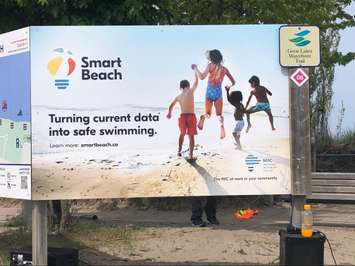
The Municipal Innovation Council has seen a successful first year of gathering data through its three year Smart Beach Pilot Project.
This summer, the Smart Beach team collected wave, current and wind data. Their goal is to develop a real-time warning system that will provide beachgoers with information on local water conditions, including rough surf and the presence of rip currents, to improve beach safety in the Great Lakes.
With recorded wave swells this September of up to 2.3 metres in height, the project is already demonstrating the changeable, and potentially dangerous, nature of Lake Huron.

Over the winter, researchers will use this data to train a machine learning model to understand and predict when waves and rip currents form at Kincardine’s Station Beach.
“What a successful first year for the Smart Beach project,” said Dr. Chris Houser, Dean, Faculty of Science at the University of Windsor and lead researcher on the Smart Beach technology. “We saw strong public engagement as our team surveyed beachgoers and worked closely with partner groups and the Municipal Innovation Council—and we are in good shape to move into year two of our research.”
Some of the team’s next steps include testing a communication tool that will provide real-time information on swimming conditions, install another camera system near the Kincardine Pier that will collect data on the north side, and potentially expand the Smart Beach project to another beach in the MIC member municipalities.