

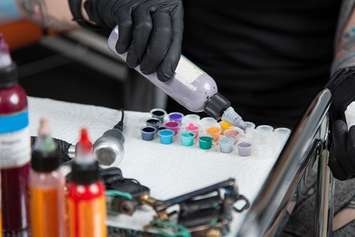
A new international study with ties to Western University has led to calls for more controls and regulations surrounding tattoo ink in Canada and the United States.
More than 70 tattoo ink samples were collected from suppliers and online retailers for the study led by Western University Chemistry Professor and Canada Research Chair in corrosion science Yolanda Hedberg.
Researchers, including those at KTH Royal Institute of Technology, the Center of Occupational and Environmental Medicine, and University of Graz in Austria analyzed the ink to find most would fail to meet industry standards.
“Nearly everyone in the world can order just about any tattoo ink they wish online,” said Hedberg, a professor in Western’s department of chemistry. “Most of these inks come from the United States and there is very little legislation governing their production.”
Hedberg noted there is European and Swedish legislation that requires manufacturers to declare information on the content, name and address of the manufacturer, minimum date of durability, sterility, batch number and storage readable on the product label for tattoo inks. There are also additional restrictions for the maximum content of certain metals and impurities, as well as recommendations to avoid certain pigments.
Ninety-three per cent of the samples examined by the research team violated those European legislative requirements.
All of the samples contained potentially harmful nickel and chromium. Among other impurities found in some of the ink samples were arsenic, mercury, copper, and lead. Several other pigments, which were either prohibited or declared as non-suitable, were found in 61 per cent of the tattoo inks including, pigment red 22, pigment red 170, pigment blue 15, pigment green 7, pigment violet 23, pigment red 122, and pigment violet 19.
These foreign, chemical substances can trigger allergic reactions in the body's immune system and can also result in severe and chronic eczema with its potentially life-threatening consequences.
“This study suggests that tattoo inks should be better controlled, and consumers should be more careful,” said Hedberg. “Least impurities have been found in black and white colors, while the most problematic substances were found in red inks. The differences between different brands were remarkable.”
In Canada, roughly 38 per cent of the adult population has at least one tattoo.
The study was recently published in the journal Contact Dermatitis.