A new report, believed to be the first of its kind in Canada, suggests driver tune-out could be a real problem in semi-autonomous vehicles.
The research suggests changes to driver training and requirements so manufacturers track crashes.
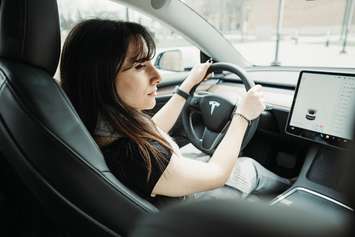
Researchers at the University of Windsor's Faculty of Human Kinetics studied 30 drivers behind the wheel of a 2022 Tesla Model 3 as they drove on Hwy. 401 to Chatham and back.
Study participants used the vehicle in both the manual and L2 semi-autonomous modes.
What they found was drivers were much more alert in the manual mode.
"We suspected this would be the case, but it was much worse than we anticipated," said Kinesiology Professor Francesco Biondi. "Some participants even started to doze off while in L2 mode."
Other drivers paid more attention to the vehicle's touchscreen than the road.
While there have been studies using driving simulators, Biondi's study could be the first time anyone has studied driver behaviour in an actual vehicle.
"Drivers are playing a more hands-off role in supervising the system -- which may result in impaired performance in resuming manual control of the vehicle whenever necessary," he said.
Drivers wore special headgear that tracked their eye movements, pupil dilation, and blink rates. Cameras recorded their head movements and what was going on on the road in front of and behind the vehicle, while a device sensed their hand-eye reaction time. Biondi's research assistant, Noor Jado, sat in the backseat to answer questions, give directions, and record data.
Even in semi-autonomous mode, drivers are expected to keep their eyes on the road and hands on the wheel, but Biondi said the research showed they weren't doing it.
"These systems are supposed to be safer," he said. "But when you consider human systems, that is not necessarily the case."
While in semi-autonomous mode, the vehicle maintains its position in its lane. Speed remains constant unless there's a slower car or truck ahead, in which case, the vehicle should slow and follow it at a safe distance. However, Biondi said the technology was less reliable in construction zones where lane markers are less discernible.
Biondi urged more study involving drivers on longer trips and in adverse weather conditions.
"As L2 systems become more common in vehicles, more research is necessary to develop a better understanding of the implications," he urged.
The Ontario Ministry of Transportation funded the report.