

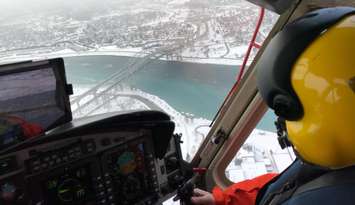
Local media got a bird's-eye view of the Canadian Coast Guard's icebreaking operations along the St. Clair River Tuesday afternoon.
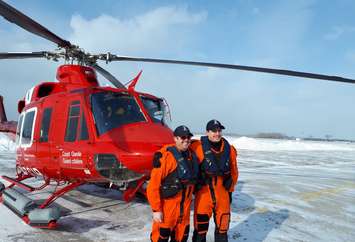
In somewhat cloudy conditions, pilot Mark Pearson and flight engineer Ryan Davis, took three reporters hundreds of feet into the air in a Bell 412 EPI helicopter.
The chopper is one of 22 newer aircraft purchased by the coast guard over the past few years-- it can reach speeds of 115 knots or 212 km/h, and typically operates at heights between 500 feet to 1,000 feet, helping protect coastal communities and waterways.
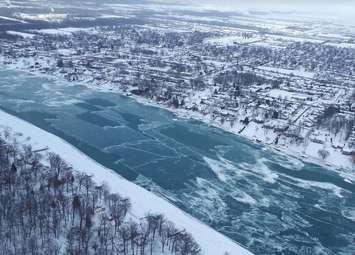
Pearson said because of the recent extreme cold, they've been busier in Sarnia-Lambton, typically flying over the area once or twice a day to mark ice conditions.
Pearson, a pilot with 20 years of experience, said the flights play a big role in icebreaking operations.
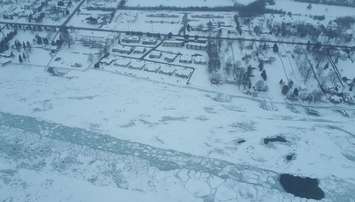
"The information we gather on these flights gets recorded to Montreal-- they can draw up maps and report on the extent of the ice conditions," he said. "And it also helps augment satellite and radar images with actual eyes assessing the ice conditions, which do change quite frequently."
Coast Guard Ice Services Specialist Jacques Collins said the conditions have certainly changed over the past week-and-a-half.
He said the amount of ice on the Great Lakes and surrounding waterways has increased to about 23 per cent, just below the 27 per cent seasonal average, and is expected to reach 35 per cent by week's end.
"We got a lot of ice starting in Lake Huron. Lake St. Clair is mostly covered in ice right now, and Lake Erie was almost ice-free last Monday, but with the cold coming in, I expect Lake Erie will be totally covered in ice by this Thursday."
Collins said the bitter cold is actually helping icebreaking efforts on the St. Clair River.
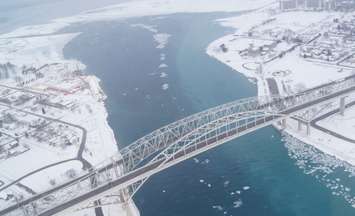
A stronger ice bridge on Lake Huron just north of Sarnia is preventing more brash ice from entering the river.
Last week, an ice jam caused flooding in East China, Marine City and Algonac, Michigan.
Collins said the situation has since improved.
"Over the next four, five days, we got those wind chill factors and dipping temperatures, so it's going to form the bridge pretty good."
Collins said warmer temperatures on Sunday and Monday shouldn't be a concern.
During the 2017-2018 icebreaking season, the Canadian Coast Guard responded to 1,252 requests for icebreaking.
They called last winter one of the most demanding icebreaking seasons to date on the Great Lakes-- both the Canadian and American coast guards helped 637 ships navigate the Great Lakes during that time.
[video width="1280" height="720" mp4="https://blackburnnews.com/wp-content/uploads/2019/01/video-1548792827.mp4"][/video]