

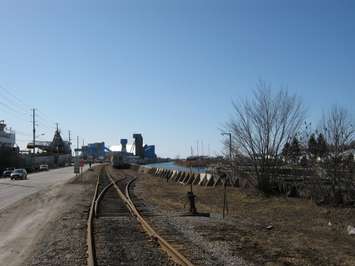
Compass Minerals has received provincial approval for a major new salt development area beneath Lake Huron as the company adjusts its long-term mine plan around unexpected geological conditions.
An Order in Council approved August 13, 2026 authorizes Ontario's Minister of Energy and Mines to issue Compass Minerals Canada Corp. a 21-year lease for mining rights on Crown land west of Goderich.
The new area covers about 1,592 hectares, or nearly 16 square kilometres, beneath Lake Huron roughly 6.2 kilometres west of the community.
It sits beside the western boundary of one of Compass Minerals' existing mining leases.
The provincial order authorizes "a lease of mining rights only for a period of 21 years."
Documents prepared through the environmental assessment process show the application is tied to geological problems encountered elsewhere in the underground mine.
The Ministry of Energy and Mines says Compass has discovered anomalies in the northwestern portion of its existing lease that require more investigation.
"They have discovered geologic anomalies in the northwestern region of lease 110134 that requires additional assessment and exploration," the provincial project description says.
Those conditions prompted the company to develop an alternative mining plan that would shift future development farther south and west while assessment of the affected area continues.
The province says Compass has identified high-quality salt near the western boundary of the existing lease and already has historic mine workings relatively close to that area.
"To that end, to optimize their mining configuration, they need to expand their exploration area by an additional 2 kilometers," the project description says.
The Ministry says the additional land would give Compass greater flexibility to continue developing the salt deposit while accounting for mine stability and the geological conditions found elsewhere.
The overall Goderich operation is currently expected to remain active until 2094, according to provincial documents.
Compass Minerals describes the Goderich site as the world's largest underground salt mine.
The mine has operated since 1959 and extends roughly 1,800 feet beneath Lake Huron.
Salt produced in Goderich is shipped throughout the Great Lakes and St. Lawrence Seaway region, with much of it used for winter road maintenance.
Before the lease could move ahead, the proposal underwent a provincial Class Environmental Assessment as a Category B project.
The Ministry concluded that “low to moderate environmental impacts are anticipated” from issuing the lease, while noting any future mining activity remains subject to other regulatory and environmental requirements.
The assessment considered potential impacts involving groundwater, surface water, drinking-water sources, vibration and ground subsidence.
A subsidence study completed in 2024 found the area around the mine's shafts and infrastructure, as well as the shoreline near Goderich, is expected to experience minimal subsidence over the next 100 to 200 years.