

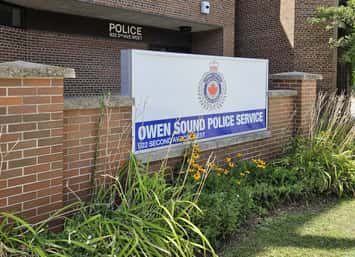
The six candidates running to become Owen Sound’s next mayor are divided over whether the city should pursue an Ontario Provincial Police costing, and even more sharply divided over what should happen if the provincial force can provide policing for less money.
Owen Sound council voted 6-3 in July to direct staff to explore what would be required to obtain a formal OPP costing, as councillors wrestled with rising policing costs and the future needs of the city’s aging police station.
The city has not yet requested the costing itself.
The discussion comes nearly a decade after Owen Sound last went through the process. Council requested an OPP proposal in 2016 and ultimately voted unanimously in 2017 to retain the Owen Sound Police Service.
With the issue likely to carry into the next term of council, CKNXNewsToday.ca asked all six candidates for mayor the same three questions: whether they support obtaining a formal OPP costing, whether lower costs alone would be enough to support changing police services, and what public consultation they would require before a final decision.
Their answers ranged from strong support for examining n(and potentially moving to) the OPP, to firm backing for the existing municipal service. But all six said residents should have an opportunity to weigh in before a final decision.
Former mayor and councillor Richard Thomas is among the clearest supporters of keeping the Owen Sound Police Service. Thomas pointed to his own history with the issue, noting he was the councillor who brought forward the motion that led to the city's previous OPP costing.
"I was the one that brought the motion 10 years ago to do an OPP costing," Thomas said. "And at that time, when the results came in in 2017, city council voted unanimously to remain with the Owen Sound Police Service."
Thomas said the previous comparison anticipated the municipal police service becoming more expensive than the OPP later in the agreement, but argued subsequent increases faced by OPP-policed municipalities demonstrate how quickly those projections can change.
"As far as I'm concerned, nothing has changed since the last OPP costing,” Thomas said. “And I continue to support the Owen Sound Police Service."
He said he has "no doubt" a new OPP proposal could initially appear less expensive, but would not support changing services based on that difference.
"I think we get excellent service on so many levels from the Owen Sound Police Service that I would not favour a change," Thomas said.
Thomas also pointed to recent increases in OPP policing costs elsewhere in Ontario and said Owen Sound Police Service budget increases have remained toward the lower end of that range.
If the issue were to proceed, Thomas said he would expect public involvement, although he stopped short of prescribing a particular consultation model.
"I don't think any decision is made in a vacuum at the city," he said. "The elected officials represent the people. I would say there would absolutely be public input if things were to proceed."
Ray Botten, by contrast, supports obtaining the costing and said a significant enough financial advantage could persuade him to support the OPP.
"I do support it, but I want to say that we're revisiting the same question, maybe the third time, at least twice, in the last number of years," Botten said. "So there must be a reason why the city is asking that."
Botten said taxpayer value has to be central to the decision.
"I believe that we need to always be wise with our money for the taxpayer," he said.
He also raised concerns about police recruitment. Botten said he has spoken with Owen Sound Police Chief Craig Ambrose and came away concerned about the ability to attract enough officers to the city.
"It's a real problem," Botten said. "They're having trouble having enough officers. So I'm very much for an OPP costing and also possibly bringing them into Owen Sound."
Botten said residents must be directly involved before council makes that choice.
"We have to have input from our residents, absolutely, because without their voice being heard personally, how can we actually make the right decisions?"
Jodi King is also receptive to an OPP costing, but said she wants firm numbers before taking a final position.
"I won't support anything just yet until I know the exact budget for Owen Sound," King said.
King said she has heard significant interest in the OPP from residents and believes the eventual question should go beyond council chambers.
"I would also ask for a public referendum for people's support or votes," she said. "It's ultimately up to the citizens."
Unlike some of her opponents, King said lower policing costs could be sufficient to win her support for a switch, particularly if the savings could be redirected toward other pressures facing the city.
"Yes, 100 per cent it would," King said when asked if cost savings alone could justify a change.
She suggested money freed up from policing could be directed toward homelessness, mental health and addiction services, while also saying public safety and visible patrols remain a major concern.
"If we have, again, approximately $1 or $2 million left over from the police budget, I would like to see any remaining funds directed to more important issues, again, like the homeless situation and the drug addiction," King said.
King said any referendum should form part of a broader public process, including an opportunity for residents to attend a larger public meeting.
"The city has to be more transparent," she said. "Owen Sound residents need to know what's going on in their city."
Andrii Zvorygin said he would be open to a formal costing, while stressing that price should only be one part of a broader examination of how policing and other community services are delivered.
“I would be open to obtaining a formal OPP costing, though Owen Sound received one fairly recently in 2017,” Zvorygin wrote in his response.
He said any model should consider how police interact with other responders, particularly on mental health, wellness and lower-risk calls.
"Price would be one factor among several," Zvorygin said. "Any police service would need to cooperate with civic responders for civil matters, civilian teams for screened low-risk mental-health and wellness calls, and police focused on high-risk situations requiring police authority."
Zvorygin tied the policing discussion to his support for zero-based budgeting and a broader effort to reduce the underlying pressures that generate repeated police calls.
He argued that properly trained civilian and civic responders could resolve some situations through de-escalation, while affordable housing could help reduce instability that contributes to petty crime and repeated contact with police.
"As demand declines, police staffing and spending should be adjusted to the remaining workload," he said.
Before any decision, Zvorygin said the city should give residents considerably more than a headline comparison of annual police budgets.
"Residents should receive the complete proposal and a clear ten-year comparison covering costs, staffing, service levels, transition expenses, local employment, dispatch, and included services," he wrote.
He also called for a public meeting and opportunities for residents to question the proposal before council votes.
Mike Seiler took a more philosophical approach to the question and expressed concern about shifting local authority to a provincial organization.
Seiler said the request from CKNXNewsToday.ca was the first time he had encountered the term "OPP costing," and he researched the issue before submitting his response.
"While I have a great deal of respect for all the OPP does for Ontario, I do not believe it is in the best interest of a developing municipality like Owen Sound to rely heavily on provincial services," Seiler wrote.
His opposition is rooted less in the specific cost comparison than in his preference for local decision-making.
"My concern is that injecting provincial policing into our municipality works against local democratic governance," he said. "It centralizes authority rather than keeping accountability within the community being policed."
Seiler said Owen Sound and Grey-Bruce have unique challenges best understood by people who live in the region, and he sees the OPP's natural role as more closely connected to provincial infrastructure and highways while municipal forces retain local independence.
Asked whether a cheaper OPP proposal would be enough to change his position, Seiler did not identify a price point that would do so. Instead, he said the city's focus should be on changing programs and creating economic growth rather than simply reacting to existing costs.
"My focus is on creating a future where we aren't just reacting to costs, but building growth," he said.
Like King, Seiler wants residents to ultimately vote on the issue.
"I would advocate for a city-wide vote," he wrote. "I want to ensure our residents have the final say on this matter."
Carol Merton, a current Owen Sound councillor and member of the Owen Sound Police Service Board, is taking a more incremental position.
Merton said she supports first determining exactly what would be involved in an OPP costing before committing taxpayer dollars to a full study.
"I support exploring the process of a costing before a full formal study paid for by tax dollars," Merton said. "We don't want to disrupt our local police service without a clear process and, obviously, financial justification."
Merton characterized that first step as fiscal due diligence rather than a signal council intends to abandon the municipal force.
"Exploring options is fiscally responsible leadership and does not necessarily indicate a commitment to accepting any proposal solely on the numbers," she said.
Merton was emphatic that a cheaper OPP contract would not, by itself, convince her to support a change.
"No. Lowering operating costs on paper are not enough on their own to justify changing our police service," she said.
She said council would have to consider long-term operating costs, transition costs, service levels, local governance and relationships between police and community organizations.
Merton also cautioned that a proposal appearing cheaper annually could require substantial upfront spending for items such as severance, pensions, facilities and technology.
"A proposal that looks every year cheaper can actually take eight to 10 years just to break even," she said.
She placed particular emphasis on the value of local control, arguing Owen Sound's current model allows policing priorities to be tailored specifically to the city.
"Maintaining local governance and accountability serves our local citizens well and helps us to determine our policies and prioritize localized strategies," Merton said.
If council eventually obtains a formal proposal, Merton said she would support what she described as a "comprehensive multi-stage public consultation process."
That would include not only residents, but businesses, social service agencies, people with lived experience, the hospital, mental health and addiction organizations and downtown business representatives.
"Taxpayers deserve complete transparency, independent financial validation, and multiple open forums to ask questions and voice their priorities," Merton said.
She said the public should see an itemized accounting of transition costs and five- to 10-year projections, with municipal finance staff, police board representatives and independent experts available to answer questions.
"My commitment is to lay all the facts, numbers and service trade-offs on the table and let our community, our stakeholders and service providers have the time to provide their input," Merton said.
Merton also suggested the debate need not be limited to choosing between the existing service and the OPP. She said municipalities facing rising costs and police recruitment challenges could examine regional sharing of functions such as information technology, administration, grant writing, data analysis and policy development.
The answers leave Owen Sound voters with several distinctly different approaches to one of the largest expenses the next council will face.
Botten and King appear most willing to consider an OPP transition if the financial case is strong, while Thomas remains firmly behind the existing municipal service. Merton and Zvorygin support gathering more information but say cost cannot be considered in isolation, while Seiler's concerns centre on maintaining local independence and limiting the transfer of authority to the province.
Where the candidates largely converge is on what should happen before any final vote: Owen Sound residents should see the information and have an opportunity to be heard.