
With calls for assistance from regional hospitals increasing, London Health Sciences Centre's (LHSC) neonatal paediatric transport team will be adding a third shift.
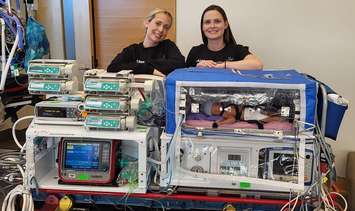
The team, one of only four in the province, currently runs two 12 hours shifts each day. It is made up of 20 registered nurses (RN) and respiratory therapists (RT) with specialized knowledge and equipment. Their job is to stabilize extremely sick preterm infants, children, and teens at hospitals from Windsor to Kitchener, to as far north as Red Lake and Thunder Bay and bring them back to Children’s Hospital in London.
"Right now we have one team on days and one team on nights. We are looking at having a third team to supplement that mid-bridge, so another RT and another RN to go out," said Leeann Trowbridge, team member and respiratory therapist.
Since the start of the year, the team has been called to approximately 900 patient transfers, including that of a toddler who nearly drowned in a backyard pool at a Petrolia daycare. The team was instrumental in saving the 2-year-old's life.
The third shift is expected to be added in January, a particularly busy time when the respiratory season will be in full swing.
"Last year during our third quarter, which is from October to the end of December, we had about double our paediatric call volume, plus our neonatal, so much higher volumes than we have ever seen," said Trowbridge. "This is why we are looking at getting an extra team."
It takes roughly 18 months of additional training before an RN or RT can be certified as Provincially Certified Transport Clinicians. The training includes in-class learning, preceptor time, and transport-specific education. Trainees also have to undergo a series of provincially-mandated simulations.
The team works in partnership with local EMS and ORNGE to transport patients by land, airplane, and helicopter. They have a mobile ICU and work in consultation with Children’s Hospital physicians.
"Before we leave [the regional hospital], we call our doctor. We give them an update, we make plans for A,B,C,D, E, and then if we hit F we are trained enough to be able to manage F, even if we didn't plan for it," said Trowbridge. "We have to plan for all the things that could happen, especially when we are in the air because we are in a tiny little tube with not much mobility."
Children's Health Foundation works to raise the necessary funds to buy the team's highly specialized equipment.