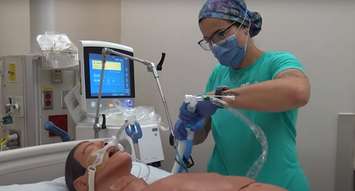
Scientists at London's Children's Hospital and Toronto's SickKids hospital are looking to enroll 60 critically ill paediatric patients into a new inhaled sedation pilot study.
Researchers believe the new method of sedation would improve outcomes for patients by reducing neurological complications.
"Many sick children need support from a ventilator and other life-saving treatments, and may require intravenous (IV) sedatives to tolerate these uncomfortable therapies,” said Dr. Rishi Ganesan, an associate scientist at Lawson Health Research Institute and paediatric neurocritical care physician at Children’s Hospital at London Health Sciences Centre (LHSC). “However, our current sedation options may contribute to a complication called delirium. We are interested in evaluating if delirium and long-term neurological complications are lower in children receiving inhaled sedation compared to those receiving IV sedation, which is the current standard of care.”
Delirium is an acute change in mental state that can include confusion, disorientation, agitation, excessive drowsiness or poor attention.
The study is being conducted by Lawson, Sunnybrook Research Institute, and SickKids and is funded through a Canadian Institute for Health Research grant. It builds on research by Lawson Scientist Dr. Marat Slessarev and Sunnybrook Scientist Dr. Angela Jerath, who have been comparing inhaled sedation to IV sedation in adults since 2020.
“One of the challenges with IV sedation is that we do not have a way to measure the level of sedatives in the blood,” said Slessarev. “Critically ill patients that are sedated can sometimes develop issues with the kidney and liver, which are both important in eliminating the sedatives from the bloodstream.”
According to researchers, inhaled sedatives are used safely in operating rooms daily, widely available, and are inexpensive.
For the pilot study, half of the 60 participants being sought would be given inhaled sedation while the other will receive standard IV sedation. Upon the completion of the pilot phase of the trial, scientists hope to expand the study to paediatric intensive care units across the country.
“This has the potential to change how critically ill children are cared for in paediatric ICUs across Canada and the world,” said Ganesan. “We hope that inhaled sedation makes a difference in children’s long-term functional outcomes, so they can thrive and achieve their full potential.”