

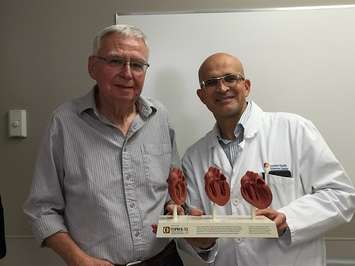
In a first-of-its-kind cardiac surgery, the London Health Sciences Centre (LHSC) has used a robot to replace a key heart valve.
A multidisciplinary team, led by LHSC Chief of Cardiac Surgery Dr. Bob Kiaii, replaced a Straffordville man's calcified aortic valve using the hospital's da Vinci surgical system. The delicate procedure uses a tissue valve, which does not need sutures to stay in the correct place. While the tissue valve has been used for some time, this was the first time in the world a robot was used on a patient diagnosed with aortic stenosis.
“We have been working for some time to perfect this procedure, knowing it would be of great benefit to some of our patients,” said Kiaii. “By using the robot, we were able to perform this surgery much more easily without disturbing the breastbone, with much better visualization. This results in far less traction on the ribcage, and reduced trauma to the surrounding area.”
Aortic stenosis is one of the most common and serious valve disease problems, because it restricts the blood flow from the left ventricle to the aorta.
The new less-invasive approach to this cardiac surgery has led to an easier, less painful recovery for patient James Fuller.
"I have friends who have had the open chest version of this surgery, and my experience has been so different than theirs,” said Fuller in a statement. “There is no comparison in the level of pain or in the amount of time it took me to recover and get back to my normal activities.”
Prior to the surgery , Fuller said he would get short of breath after walking just a few steps.
"Now, I feel like I can do anything I want, and I just keep feeling better every week. I’ve always maintained an active lifestyle, and thanks to this surgery, I’ve been able to resume that,” said Fuller.