

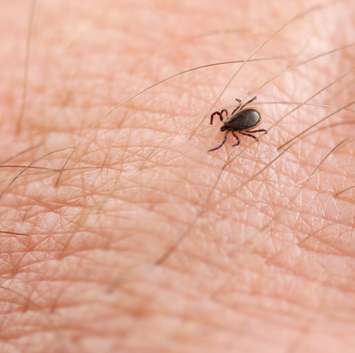
Health officials in Elgin County are issuing another warning about the dangers posed by ticks after one tested positive for the bacteria that causes Lyme disease.
Southwestern Public Health, the health unit created by the merger of Oxford County Public Health and Elgin-St. Thomas Public Health, said the bacteria was found in a black-legged tick collected from the Port Burwell area.
"Black-legged ticks, also known as deer ticks, are known carriers of Lyme disease and thrive in environments like tall grasses, woods, and bushes," Southwestern Public Health said in a news release issued Wednesday. "Public Health Ontario has identified a few areas near the Southwestern Public Health region, including popular parks like Turkey Point and Long Point, which are considered risk areas for ticks that carry Lyme disease."
Symptoms of Lyme disease include fever, headache, pain in muscles and joints, fatigue, and an expanding red rash. The rash can sometimes look like a bull's eye. Without treatment, Lyme disease can lead to arthritic symptoms, heart problems, nervous system disorders, and extreme fatigue.
“Residents need to take notice that a tick has tested positive for the bacteria that causes Lyme disease in Elgin County," said Peter Heywood, director of health protection at Southwestern Public Health. "We all want to get out and enjoy our beautiful trails and all the activities the spring and summer have to offer, but we also need to make sure we are protecting ourselves from ticks. We all need to make sure if we’re going into an area where ticks may be found, we are covering up, using DEET repellant and then checking yourself, family members and pets over for ticks when you can.”
To avoid contact with ticks, Southwestern Public Health recommends people use an insect repellant that contains 20%-30% DEET, wear long sleeves and fully closed footwear when walking in tick-prone areas, wear light coloured clothes so that ticks are easy to spot, and do a "tick check" to see if any ticks have attached themselves to you. They can hide under the armpits, behind the knees, in the hair, and the groin.
"If you find a tick on yourself or a family member, carefully remove it with fine-tip tweezers and submit it to Public Health for identification. If you remove a tick quickly (within 24 hours) you can greatly reduce your chances of getting Lyme disease," Southwestern Public Health said.