
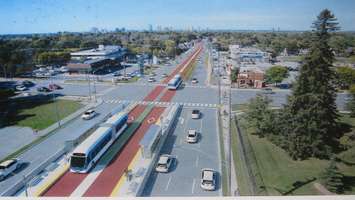
The issue of bus rapid transit (BRT) returns to city hall next week, as politicians will be presented with an updated business case for the controversial plan.
The revamped business case and transit master plan goes to the strategic priorities and policy committee on Monday. The plan for the single biggest infrastructure project in London’s history had to be updated to reflect major route changes approved by council in May.
Councillors nixed the proposed tunnel beneath Richmond Row, instead opting for street-level dedicated bus lanes along Richmond St. That decision came after the estimated cost of the 900-metre tunnel jumped from $90-million to $170-million. Councillors also decided to split the east-west corridor between King St. and Queens Ave.
The changes dropped the overall cost of BRT down to $440-million. But the updated business case puts the estimated price tag at $500-million to account for inflation over the construction period.
"The Ministry of Transportation requires that the city use nominal dollars in the business case and when discussing any request for funding. Nominal dollars represent the cost of the project over the construction period including an escalation for inflation. London’s Rapid Transit project is $440-million in real dollars and $500-million in nominal dollars," staff state in the report that accompanies the updated business case.
Also included in the business case is the Adelaide grade separation project, which would stop trains from creating roadblocks and traffic congestion on Adelaide St. between Central Ave. and Pall Mall St. The preliminary cost of the project is estimated at $60-million. Council voted to fast track the project in May so that it will be completed before the implementation of the northern BRT corridor.
London’s financial contribution to BRT is capped at $130-million. Once the updated business plan is approved, the city can move forward with formal requests for funding from the federal and provincial governments.
The city intends to gain federal funding through the Public Transit and Green Infrastructure streams. Through these streams of funding, the feds will cover up to 40% of total project costs. At the provincial level, the government has set aside up to $15-billion for municipal infrastructure projects outside of the Greater Toronto and Hamilton area.
According to the business case analysis, "implementation of the Full BRT alternative with the approved corridors provides a positive financial return on investment and is the best overall value solution from a mobility, city building, economic development and financial affordability perspective."
An environmental assessment and refined conceptual designs will continue through the next phase of the massive project.
The 24 km system of high-frequency buses will bisect the city on L and 7-shaped corridors. The routes north to Masonville mall through Western University, south of Wellington Rd to White Oaks Mall, east of Wellington to Fanshawe College, and west of Thames River to Oxford St./Wonderland Rd. were also approved in May.