
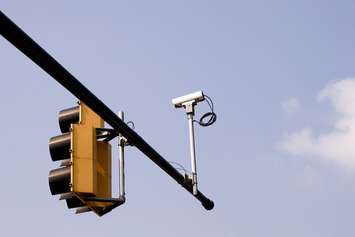
Some motorists may not be happy about it but city staff is recommending council give the green light to red light cameras.
A report on the controversial cameras goes to London's civic works committee on January 5. In the report, staff recommends 10 cameras be rotated between as many as 22 city intersections to bust drivers who speed through red lights.
"We had a pretty good discussion last meeting on the same issue," says Councillor Jesse Helmer, chair of the civic works committee. "People on the committee had some really good questions. We will also look at other alternatives out there to red light cameras that would have the same kind of reduction on collisions. There is broad agreement that we need to do something to decrease red light running and improve road safety. The question is what is the best approach and I'm looking forward to that discussion with my colleagues."
If approved, the cameras could be operating by 2017 and anyone recorded running a red would be mailed a $325 ticket.
The five-year contract to supply, maintain and provide data transfer services would go to American company, Trafficpax LLC, while the City of Toronto would issue the fines from its central processing centre.
"This is an example of municipalities working together to deliver the lowest cost program in a joint effort," says Helmer. "We worked together to develop the request for proposals, find one vendor who can do all of the work for the different municipalities. We concentrate the processing with the City of Toronto so there is one processing facility instead of a whole bunch of individual ones, which would be more expensive for all municipalities overall. So I think this is the most cost effective approach. Frankly, I'd like to see municipalities do more of this kind of cooperation."
The report says red light running has been identified as the 6th highest cause of injury or fatal collisions. Studies have shown intersections equipped with the cameras see a 25% drop in the number of angle crashes. However, the number of rear-end collisions jumps to 15%, as more drivers brake for the red light.
"One thing that is interesting about red light programs is that even at intersections where they are not installed you see decreases in the number of people running red lights," says Helmer. "That's because people aren't sure where all the cameras are so they start slowing down and stopping at all intersections."
Since 2000 six municipalities in Ontario, including Toronto, Hamilton, Ottawa, Peel, Waterloo, and Halton have used red light camera enforcement. Kingston and York Region plan to implement the cameras in 2017.
The cameras come with a $3.8-million price tag but are expected to generate $4.5-million in additional revenue for the city over five years.