
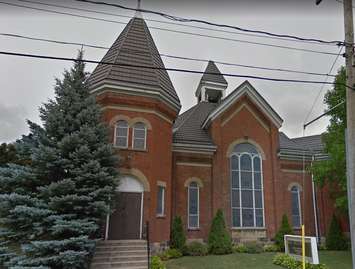
There's a strong possibility that a 125-year-old church in Blenheim could soon be gone for good.
On Monday night, council voted in favour of not moving forward with a staff recommendation to designate the former Blenheim United Church under the Ontario Heritage Act.
Located at the corner of George Street and McGregor Street in Blenheim, the church was built in 1895 with three additions built throughout the years -- a gymnasium and Sunday school wing, a Christian education wing, and an addition that addressed accessibility issues.
Because of its cultural value, the Blenheim United Church property was added to the Municipal Heritage Register in 2010. However, without being formally designated under the Ontario Heritage Act, the only obligation of the owner is to provide the municipality with a 60-day notice of plans to demolish the structure. The 60-day period is intended to provide the municipality time to evaluate whether the property merits protection through designation under the Ontario Heritage Act.
"The recommendations attempt to find a path forward, recognizing the 125-year history of this building in that the property move one step towards designation...it would allow the municipality and council time to consider a future development proposal should one come forward that provides a little more certainty of what could replace this building rather than lose the building in its entirety," said Manager of Planning Services Ryan Jacques.
In September, the new owners of the church property, a local couple, wrote a request to council asking that the building be taken off the Chatham Kent Municipal Heritage Register. According to the owners' request, their intent is to demolish the structure and build six senior citizen dwellings that are 1,200 square feet each.
"We choose this location because of its proximity to the downtown core, medical and dental clinics, drug stores, post office, banks, churches, etc. Ideal for seniors. The existing structure cannot be used as-is," read the request.
Despite the owners of the church property requesting that it be removed from the heritage register, municipal staff recommended that council instead approve an intent to designate the church building under the Ontario Heritage Act as a way to provide interim protection of the building and allow council the opportunity to consider more information. Although staff was not in favour of demolishing the original church structure, it was recommended that council move forward with allowing the owners to demolish the three additions that had been built on the existing structure.
Staff noted that there had been no formal plans for the property submitted by the owners of the church. Staff added that any development intent was preliminary in nature and had not been properly vetted to determine its viability.
However, many councillors were in agreement that the church was in such a bad state of repair, and it wasn't in the town's best interest to try and designate the property, which would prevent future development on the land.
"It's in a bad state of repair, the cost of the restoration would be in the millions of dollars... I have really mixed feelings on this because of the costs of the restoration and the usage afterwards really limits it," said Councillor John Wright. "Being on the Hertigate Committee, it's a hard decision. But, there's got to be a common-sense decision at the end of it. "
According to a deputation from the new property owners, an environmental study showed "significant" issues with mould and asbestos in the building, adding that it would be near impossible to salvage the existing property.
Councillor Trevor Thompson described the possibility of saying goodbye to the historic building would be tough but also noted that he hadn't received any calls from citizens who were opposed to demolishing it.
For Thompson, he said he believed that the legacy of the church would be better served by creating something new and beneficial for the community rather than continuing to allow the building to slowly decay.
"There's some sadness in the community. But I think everybody's been really [sensible] about what exactly it would take to repair and renovate this building," said Thompson. "It's just not economically feasible... It is unfortunate, I think that we would lose a building like this. However, it's better than letting it fall into disuse... It will be a shame to lose the building but it is the right thing to do. If we can see some good come out of the property, as the proponents are suggesting, then that is the best thing we can do for this corner of Blenheim and we'll remember what used to sit there."
Council ultimately voted against the intent to designate 81 per cent to 19 per cent.