

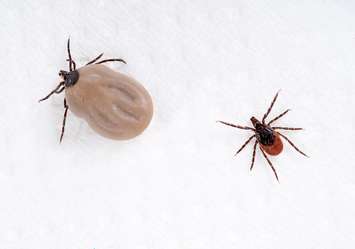
The population of blacklegged ticks may be expanding in Ontario, but the pests haven't burrowed their way into local conservation areas in Chatham-Kent yet.
Officials with the Lower Thames Valley Conservation Authority (LTVCA) say that's a good thing because that species of tick, also known as a deer tick, can carry Lyme disease.
A team of researchers from the University of Guelph visited the Longwoods Rd., C.M. Wilson, and Two Creeks Conservation areas this summer and checked them for blacklegged ticks, but their search came up empty.
LTVCA officials say that "suggests the the current risk of Lyme disease from blacklegged ticks in [these conservation areas] is low."
However, there is still an area in Chatham-Kent where people should take extra precautions to protect themselves against the ticks. Public Health Ontario has identified Rondeau Provincial Park as a "risk area" for Lyme disease.
Blacklegged ticks live in wooded areas, tall grasses, and bushes. They are most commonly found in areas along the north shores of Lake Erie, Lake Ontario, and the St. Lawrence River. Not all blacklegged ticks carry Lyme disease, but if you find one, you should submit it to the Chatham-Kent Public Health Unit for testing.