

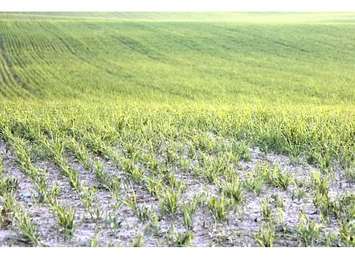
Ontario corn planting is about 90 per cent completed.
OMAFRA says some of the heavier soils in Essex and Lambton have yet to be planted.
The ministry reports corn has recovered from the frost injury of two weeks ago.
About 80 per cent of the Ontario soybeans have been planted.
That's down to about 50 per cent in Essex and Lambton.
And most of the canola planting is now complete, with some flea beetle damage reported already.
Growers are reminded this is the time to set up monitoring traps for swede midge.
The latest OMAFRA Field Crop Report says stripe rust infection in the wheat crop has spread from the southwest into Huron and Bruce Counties.
Specialists recommend growers continue to scout their fields and if stripe rust is a problem, they should spray immediately.
The caution is to be aware of the wheat stage.
Once the wheat reaches boot stage the application of some product could increase the amount of mycotoxins in the grain.
And OMAFRA says forage quality drops rapidly for winter cereal rye and orchardgrass as those crops mature.
The ministry reports some growers have begun harvesting their forages with the hopes ot taking four cuts this season.
===
OMAFRA Field Crop Report – May 25, 2016
By: The OMAFRA Field Crop Team
Corn Planted acreage across the province is at about 90% complete, with exception of some of the heavier soils in Essex and Lambton counties yet to be planted. Most of the corn acreage has emerged and is at the spike to first-leaf over stage with the most advanced corn at the two-leaf over stage. Corn has recovered from the frost injury of 10 days ago.
Some pre-side-dress nitrogen testing (PSNT) will begin next week (see table 1.). Early soil nitrate testing has shown higher than expected soil nitrate levels considering the cool, dry weather thus far this spring. Table 1. Nitrogen Recommendations Based on Nitrate-Nitrogen will soon be available at http://fieldcropnews.com/
Cereals Winter wheat is at the Zadok 37 to 55 (flag-leaf half emerged to head half emerged) stage looking good in most areas of the province. Stripe rust infection spread last week from the southwest (Windsor to London) to Huron (Exeter) and Bruce County (Walkerton). Fields with strip rust tolerant varieties or were sprayed early at the T1 stage, have less pressure. Higher nighttime temperatures should slow the development and spread of strip rust (optimum 10-20 oC). Growers should continue to scout their fields and if stripe rust is a problem, growers should spray immediately but be aware of wheat stage. Once the wheat reaches boot stage (Zadoks 45), the application of products containing a strobilurin fungicide may increase the amount of mycotoxins in the grain.
As we approach the flowering stage (Zadok’s 59), the use of a T3 fungicide to control Fusarium head blight will also control many leaf diseases, such as stripe rust. Weather forecast and DONcast may assist to best coordinate need for FHB fungicide application at flowering. Figure 1. Stripe rust lesions will soon be available at http://fieldcropnews.com/
Spring Cereals are now in the tillering stage (Zadok 26 to 30). Many annual weeds have emerged and growers should consider spraying.
Soybeans Soybean planting about 80% complete across the province, with the exception of only about 50% planted in Essex and Lambton counties. Some emergence concerns in the drier areas on the lighter soils, particularly east of the 400 where soybeans were planted into dry soil.
Forages Winter cereal rye is head half emerged stage. Forage quality drops rapidly as the crop matures past this stage. Orchard grass is headed now and alfalfa is at the early bud stage. A few growers have begun harvest planning to take four cuts this season. Stands with a higher percentage of orchardgrass in the forage mix should be cut soon as quality drops rapidly as the orchardgrass matures.
Canola Most of the planting is now complete. Conditions for emergence have been good. Flea beetle damage has been reported. Fields should be scouted now. This is also the time to set up monitoring traps for swede midge. The adult emergence peak is end of May to mid June. See infosheet for more information: http://fieldcropnews.com/2016/05/swede-midge-in-canola-infosheet/
Edible beans The planting of Azuki Beans started this past weekend. Edible bean growers will be planting this week. Remember to plant to moisture under the dry soil conditions.
Weed control Management of weeds will become the next priority in corn and soybeans if no pre-emergence herbicides have been applied. In soybeans, scout for weeds at around 10-14 days after planting because many annual weeds will be starting to emerge. Be mindful of environmental conditions at the time of applying post emergent herbicides that would increase the risk of off-target spray drift. In general off-target drift can be reduced when an applicator: • sprays when wind speeds are light to moderate and moving away from the any nearby sensitive crop • uses nozzles having the coarsest effective droplet size that will still achieve effective pest control • reduces the distance between nozzle and target
Go to www.sprayers101.com/spray-drift for more specific details about sprayer modification to reduce the risk of off-target drift to sensitive high value crops.