
[audio wav="http://blackburnnews.com/wp-content/uploads/2015/07/COMMENT-July-30.wav"][/audio]
Strip tillage, where a seedbed is cultivated but not the area between the rows is the future according to South West Ag, and they may well be right.
The logic is around pending changes in the regulatory world.
It goes like this: If regulatory changes around neonic pesticides remain as they are written now, their use at least as corn and soybean seed coatings will virtually come to an end. Part of the package to replace them includes tillage.
If on the other hand word of yet another major algae bloom in Lake Erie is not an exaggeration , it's a very good bet there will be stricter rules to keep nutrients on the land and out of the water ways. We've been talking about that possibility for well over a year.
The thing is keeping nutrients on the land, often means reduced tillage.
If you need to do both, and it appears you may have to, then strip till certainly seems like an option.
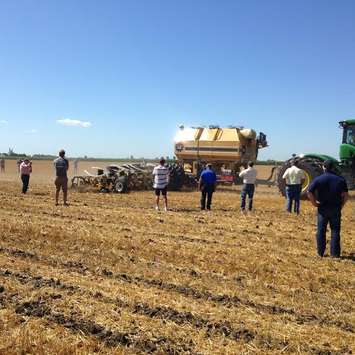
Southwest Ag likely isn't the only company thinking along these lines but it certainly is trying to move the process along. It's trying to get more than a hundred farmers involved in trials that will cover 16,000 acres.
It wants to increase your comfort level with the idea.
I know, the regulations on controlling runoff haven't been written yet, but even I have been saying for some time, they almost certainly will be.
One of the people working on bringing this together is former OMAF cereals specialist Peter Johnson, who told me very firmly recently that the days of broadcasting 200 pounds of fertilizer per acre and expecting that's going to do the job for you are over.
Wheat Pete went on to say, especially in the fall we have to find better methodology to do the right job with the right kind of fertilizer and get it where it is not going to move.
That though comes from Peter Johnson, but really we all know it is true. That fertilizer is a waste of your money if it is pushing up nitrate levels in a well, or fertilizing algae in a lake.
The good news is, with every challenge comes opportunity.
Now I am not telling you that strip tillage is right for your farm, but one has to believe there is going to be a big surge in interest over the next few years.
But the challenge will be out there. Farmers have met challenges before, and sometimes when they meet those challenges, they discover it was a step forward.
There is still too much dirty snow blowing around every winter, too much dirty water leaving tiles in spring and summer.
Changes will be coming, changes always do. We salute those who are working toward making those changes work for agriculture.
On all possible levels, the challenge and the opportunity are worth embracing .