
U.S. President Donald Trump has not allowed a Supreme Court decision striking down most of his unilateral tariffs to stop him.
Moments after the high court struck down tariffs imposed by the president through use of the International Emergency Economic Powers Act (IEEPA), Trump announced the reimposition of ten per cent global tariffs under Section 122 of the 1974 Trade Act.
The Trade Act authorizes the president to impose short-term tariffs when the United States faces significant trade deficits or "balance of pay" issues. Duties under the Act are limited to 15 per cent.
"We’re also initiating several sections, 301 and other investigations to protect our country from unfair trading practices of other countries and companies," said Trump in remarks Friday at the White House, as reported by NBC News.
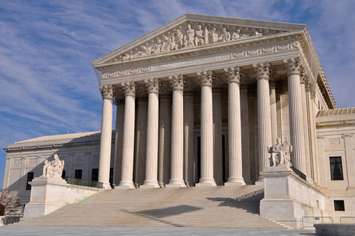
The conservative-leaning Court ruled 6-3 that the president does not have the authority to unilaterally impose tariffs on other countries, including those imposed on Canada, Mexico, and China.
Chief Justice John Roberts and two of the justices appointed by Trump during his first term, Neil Gorsuch and Amy Coney Barrett, sided with the three liberal-leaning justices against the tariffs.
In the majority opinion, Roberts wrote that Trump overstepped his authority by instituting tariffs and that it was Congress that possessed this power.
"IEEPA’s grant of authority to 'regulate...importation' falls short," wrote Roberts. "IEEPA contains no reference to tariffs or duties. The Government points to no statute in which Congress used the word 'regulate' to authorize taxation. And until now, no President has read IEEPA to confer such power. We claim no special competence in matters of economics or foreign affairs."
Justices Samuel Alito, Brett Kavanaugh, and Clarence Thomas, all nominated by Republican presidents, dissented.
Representing the minority, Kavanaugh said that the president did have the authority to impose unilateral tariffs. He pointed out that President Richard Nixon had done so in 1971 under previous legislation. The IEEPA became law in 1977.
"When IEEPA was enacted in 1977, Congress and the public clearly would have understood that the phrase 'regulate...importation' encompassed tariffs," wrote Kavanaugh. "We know as much not only because of the dictionary definitions and the traditional understanding of tariffs as a tool to regulate foreign imports."
Trump had imposed ten per cent tariffs on most countries on April 2, 2025, on what he called "Liberation Day", via an executive order.
Trump had also argued that an "influx of illegal drugs" from Canada, Mexico, and China had "created a public health crisis", even though there was no evidence that the illegal drug trade in the U.S. was completely fueled by smuggling from Canada.
Trump also cited “large and persistent” trade deficits with the three countries, claiming a detrimental effect on American manufacturing and supply chains.